PRODUCT NOT YET AVAILABLE - WORK IN PROGRESS (sorry for shouting)
The soundscape metrics data product plot is designed as an ongoing time-series (similar to the State of the Ocean plots) to quantify the natural and man-made components in the ocean soundscape. These components can often be isolated by choosing frequency bands, or even individual frequencies, to aid in analysis. One of our primary interests is to gain a better understanding of man-made additions to the ocean soundscape and how this affects biology in the Salish Sea - particularly the Southern Resident Killer Whales (SRKW) - and these changes need to be observed on longer timescales. These data products also provide users with information about the state of a given hydrophone/hydrophone array and hence can be thought of as a 'state of the hydrophones' type of data product.
These plots appear on the Data Preview tool under the "All-time" tab on locations where there are active hydrophones with deployments of at least a few weeks. The plots and accompanying data files are updated on a schedule, typically every Sunday.
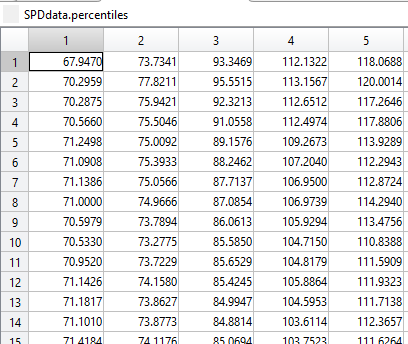
This data product uses the spectral probability density MAT files with weekly file breaks (see 51 for more information) gathered via ONC's Python client library. The frequencyBinCentres are then used to separate the data into the decadal frequency bands (10-100Hz, 100-1000Hz, ..., 10k-100kHz). Within each frequency band, the 50th percentile and linear mean sound pressure level data are averaged across that band.
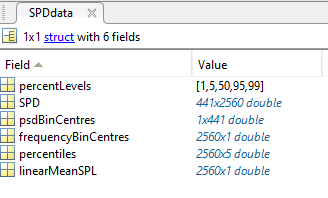
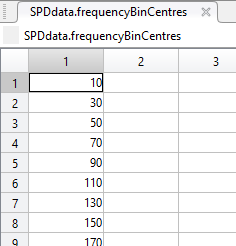
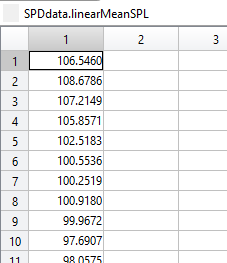
The linear mean sound pressure level is calculated based on:
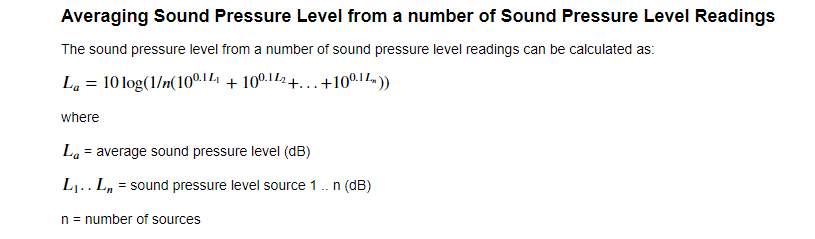
To calculate the mean value across each frequency band, the data is converted out of logarithmic space using:

After the mean value across each frequency band for each percentile has been calculated, the data is then converted back to logarithmic space:

Data gaps are then filled with NaN values. This data is plotted as one subplot per percentile, broken up by frequency band in a given subplot. Provided that the frequency values in the SPDdata structure are binned (with spacing depending on the hydrophone, but linear throughout), the closest matches to the requested frequency band are used.
Here is an example of the Soundscape Metrics plot for hydrophone A in the Strait of Georgia East hydrophone array:
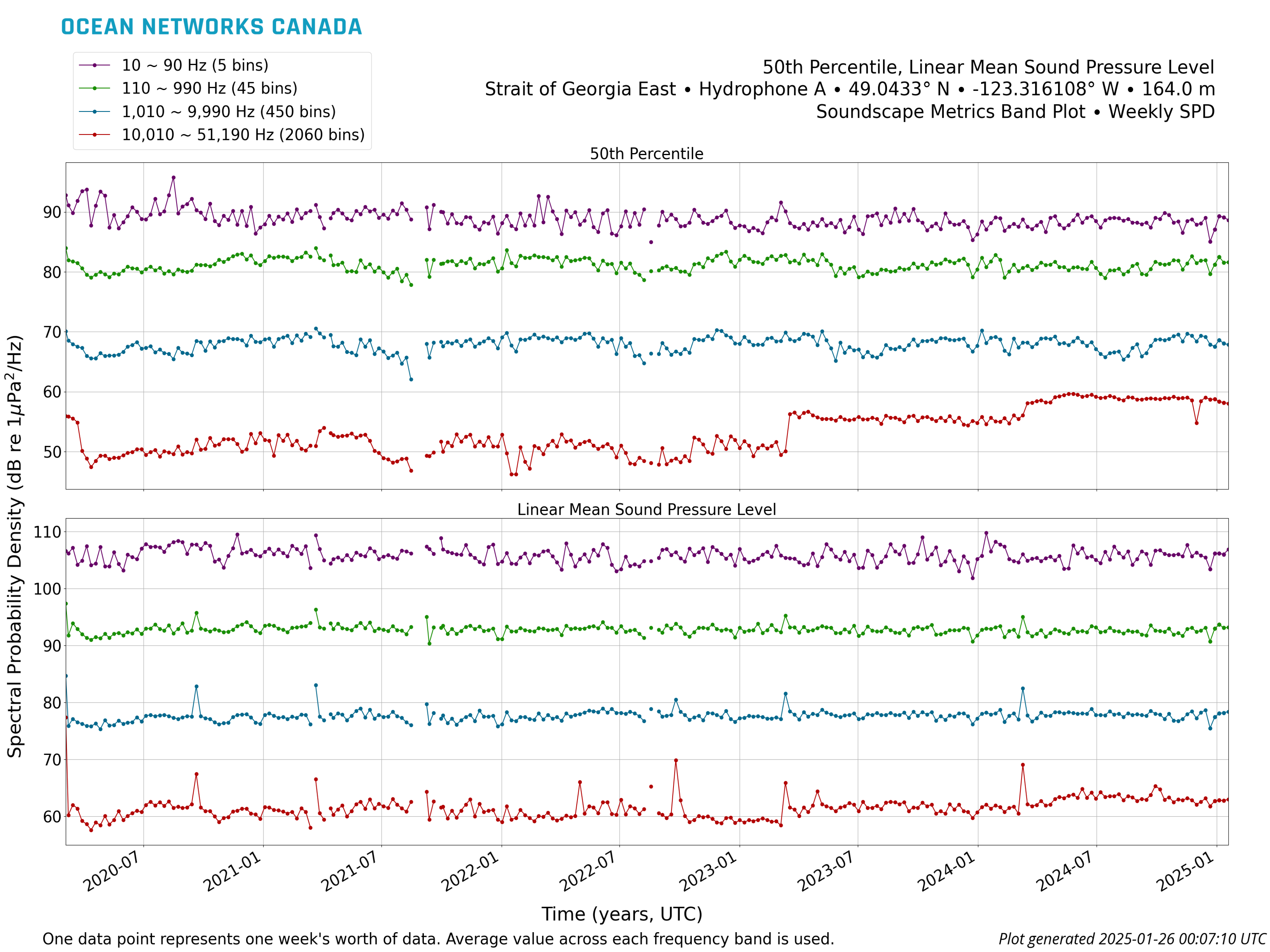
Each line represents one of the decadal frequency bands, and each data point represents one week's worth of data that has been averaged across its respective frequency band. Given that the frequency values in the SPDdata structure are binned (with bin spacing depending on the hydrophone, but linear throughout), the closest match to the frequency band for a given hydrophone is used.
In this sample plot, the lower frequency bands have greater power as they attenuate more slowly than the higher frequencies, and as a result we are able to obtain information about the soundscape at greater distances. These lower frequencies include abiotic components such as rain, turbulence, tides, and surface waves. The higher frequencies include anthropogenic components including vessels and ferries, as well biological components such as fin whales, humpbacks, and killer whales. We should expect to see lower noise levels around April 2020 during COVID, and may notice some spikes in the data in the higher frequency ranges during the busier summer months that could be associated with instrument deployments and regular maintenance.
Revision History
- 20241107: Beta product released
- 20250218: CSV, MAT, PDF format information added
- 20250424: File format metadata information updated
Formats
This data product is available in PNG, PDF, MAT, and CSV format. The data behind these plots are available via links on their display in Data Preview. Please note that these are preliminary data products and they are currently in development.
PNG
Dimensions are 3200x2400 pixels with 32 bit depth. See example above.
EXAMPLE FILE: ECHO3.H1-SoundscapeMetrics-band.pdf
MAT
MAT files can be opened using Mathworks Matlab 7.0 or later. The file contains two structures, Metadata and Data.
Metadata: Structure containing the following metadata fields, with most of the deviceDetails, deploymentDetails, and location information gathered via ONC's API webservice:

- creationDate: Char array containing the date and time (in ISO8601 format) that the data product was produced. This is a valuable indicator for comparing to other revisions of the same data product.
- deviceDetails: Structure array with the following fields:
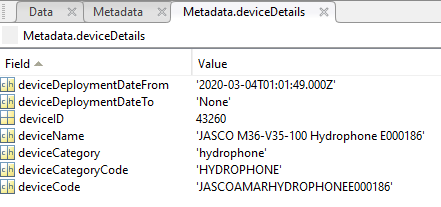
- deviceDeploymentDateFrom
- deviceDeploymentDateTo
- deviceID: Unique identifier to represent the instrument within the ONC observatory.
- deviceName: A name given to the instrument.
- deviceCategory: Unique name given to the category of devices, such as 'HYDROPHONE'.
- deviceCategoryCode: Code representing the device category. Used for accessing webservices, as described here: API / webservice documentation
- deviceCode: Unique string for the instrument which is used to generate instrument search data product file names.
- location: Structure array with the following fields:
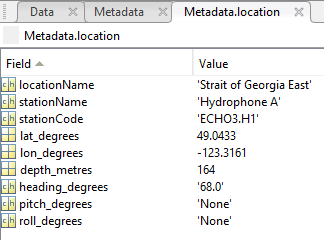
- locationName: Primary location name for the device.
- stationName: Secondary location name.
- stationCode: Code representing the station. Used for accessing webservices, as described here: API / webservice documentation
- lat_degrees: Latitude of where device has been placed, measured in degrees. Obtained at time of deployment.
- lon_degrees: Longitude of where device has been placed, measured in degrees. Obtained at time of deployment.
- depth_metres: Depth of device where it has been placed, measured in metres. Obtained at time of deployment.
- heading_degrees: Angle of device's placement with respect to the z-axis, measured in degrees. Obtained at time of deployment.
- pitch_degrees: Angle of device's placement with respect to the y-axis, measured in degrees. Obtained at time of deployment.
- roll_degrees: Angle of device's placement with respect to the x-axis, measured in degrees. Obtained at time of deployment.
- dataQualityComments: In some cases, there are particular quality-related issues that are mentioned here. This is distinct from QAQC information contained in the data structure.
- citation: Char array containing the DOI citation text as it appear on the Dataset Landing Page. The citation text is formatted as follows: <Author(s) in alphabetical order>. <Publication Year>. <Title, consisting of Location Name (from searchTreeNodeName or siteName in ONC database) Deployed <Deployment Date (sitedevicedatefrom in ONC database)>. <Repository>. <Persistent Identifier, which is either a DOI URL or the queryPID (search_dtlid in ONC database)>.
Data: Structure array containing the following:
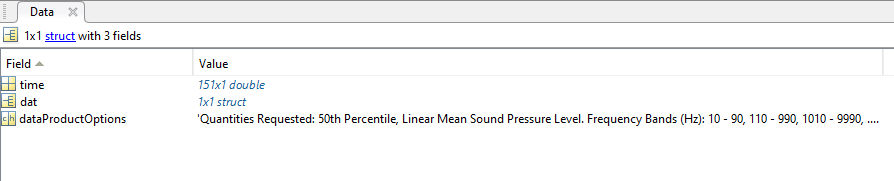
- time: Vector of data timestamps in MATLAB datenum format.
- dat: Structure array with the following fields:
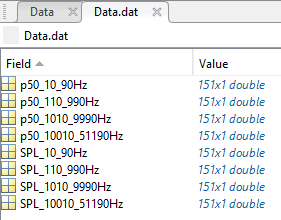
- Each variable follows the format: p<percentile value>_<frequencyLowerRange>_<frequencyUpperRange>Hz or SPL_<frequencyLowerRange>_<frequencyUpperRange>Hz
- ex. p50_10_90Hz is the 50th percentile data for the 10-100Hz band specified in the data product options (see below).
- ex. SPL_10010_51190Hz is the linear mean sound pressure level data for the 10,00-100,000Hz band specified in the data product options (see below).
- Each variable follows the format: p<percentile value>_<frequencyLowerRange>_<frequencyUpperRange>Hz or SPL_<frequencyLowerRange>_<frequencyUpperRange>Hz
- dataProductOptions: Options for this data product include:
- Percentiles and/or linear mean sound pressure level to plot. Default is 50th percentile and linear mean sound pressure level.
- Frequency bands (ranges) to split the data into and average over. Default is the decadal frequency bands (ie. 10-100Hz, 100-1000Hz, ..., 10k-100kHz). Closest matches to each requested frequency range are used.
EXAMPLE FILE: ECHO3.H1-SoundscapeMetrics-band.mat
CSV
The file is divided into sections for metadata and data. All non-data entries are preceded by the pound sign (#). Sub-sections are delimited by dashed-lines. Each metadata section and its contents are described here, and a sample can be found below.
Origin Section
- SOURCE: Citation author.
- HTTP: Citation publication site.
- HOME: Citation publication location.
- FLDATE: Creation date of the file (using ISO8601 format).
- CITATION: the DOI citation text as it appears on the Dataset Landing Page. The citation text is formatted as follows: <Author(s) in alphabetical order>. <Publication Year>. <Title, consisting of Location Name (from searchTreeNodeName or siteName in ONC database) Deployed <Deployment Date (sitedevicedatefrom in ONC database)>. <Repository>. <Persistent Identifier, which is either a DOI URL or the queryPID (search_dtlid in ONC database)>.
Location Section
- STNNAME: Station name.
- STNCODE: Station code.
- LATITUDE: Latitude north.
- LONGITUDE: Longitude east.
- DEPTH: Obtained at time of deployment (m).
Device Section
- DEVCAT: Device category.
- DEVTOT: Total number of device deployments contributing to data.
- DEPLDATE: Device deployment date.
- DEVNAME: Full device name.
- DEVCODE: Device code.
- DEVID: Device ID.
Data Section
- DATEFROM: First timestamp (using ISO8601 format) contained within the time series.
- DATETO: Last timestamp (using ISO8601 format) contained within the time series.
- DPOPTIONS: Data product options
- Percentiles and/or linear mean sound pressure level to plot. Default is 50th percentile and linear mean sound pressure level.
- Frequency bands (ranges) to split the data into and average over. Default is the decadal frequency bands (ie. 10-100Hz, 100-1000Hz, ..., 10k-100kHz). Closest matches to each requested frequency range are used.
EXAMPLE FILE: ECHO3.H1-SoundscapeMetrics-band.csv
TXT (Ocean Data View Spreadsheet File)
This file format is not available for this data product. A stand-in file has been provided for each location containing the creator, creation time, and timezone information.
EXAMPLE FILE: ECHO3.H1-SoundscapeMetrics-band.txt
Discussion
To comment on this product, click Add Comment below.